
.svg.png)
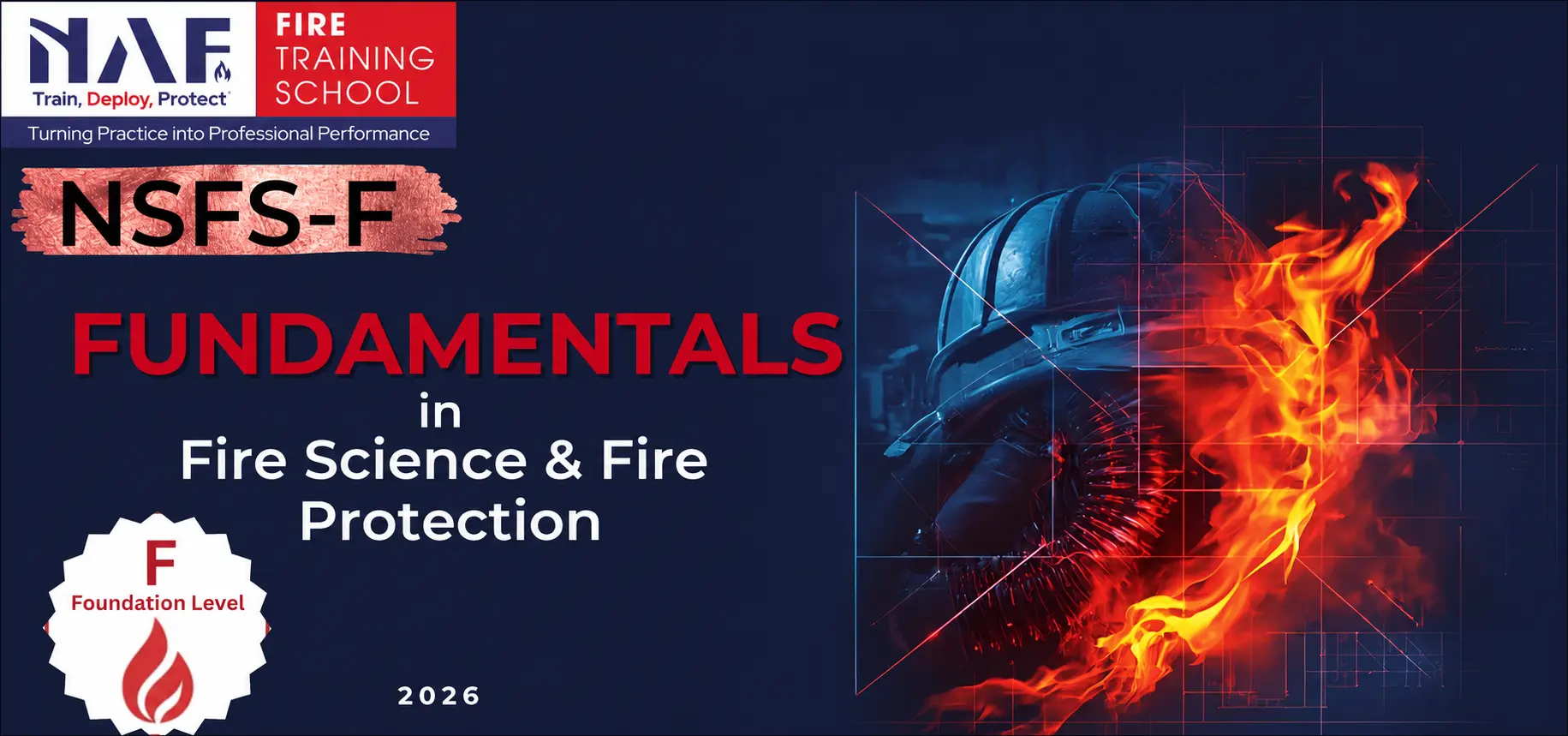
NSFS-F Fundamentals in Fire Science & Fire Protection
This foundation course provides a structured introduction to fire science, fire classifications, fire behavior, and basic fire prevention.

Instructor
dev
- Description
- Curriculum
- Reviews
1. Course Overview
This foundation course provides a structured introduction to fire science, fire classifications, fire behavior, and basic fire prevention. Participants learn the fundamentals of ignition, common ignition sources, fire extinguishing methods and agents, and the selection and use of portable fire extinguishers. The course also introduces basic fire detection and early suppression concepts, manual firefighting equipment, and essential emergency response procedures.
2. Course Objectives & Learning Outcomes
2.1 Course Objectives
-
Understand basic fire chemistry and combustion principles
-
Recognize fire classes and select appropriate extinguishing methods
-
Identify common ignition sources and fire hazards in workplaces
-
Understand the role of manual firefighting equipment and portable extinguishers
-
Apply basic emergency procedures and safe initial response practices
2.2 Learning Outcomes
-
Explain fire fundamentals, ignition, and fire growth at a basic level
-
Identify ignition hazards and recommend basic prevention measures
-
Select a suitable extinguisher type for a given fire class
-
Describe basic concepts of fire detection and early suppression
-
Demonstrate safe handling concepts of portable extinguishers and basic manual firefighting equipment
3. Target Audience
This course is designed for:
-
University students in engineering and related disciplines
-
New safety staff and facility personnel
-
Organizations’ safety and loss prevention teams
-
Newcomers to fire safety and fire protection
4. Course Modules & Time Allocation
|
Module |
Topic |
Training Type |
Duration |
|
1 |
Fundamentals of Fire Science |
Theoretical |
4 hours |
|
2 |
Fire Classification & Extinguishing Agents |
Theoretical / Practical |
4 hours |
|
3 |
Fire Detection & Early Suppression Concept |
Practical (Demonstration) |
4 hours |
|
4 |
Introduction to Firefighting Equipment & PPE |
Theoretical |
4 hours |
|
5 |
Emergency Procedures & Initial Response |
Workshop + Final Exam |
8 hours |
5. Assessment & Passing Requirements
Passing mark for this course is 70%.
|
Assessment Item |
Method |
Weight |
|
Practical Workshop |
Group exercise / demonstration |
30% |
|
Final Exam |
Multiple Choice (35 questions) |
70% |
6. Certificate
Participants who meet attendance requirements and achieve a final score of at least 70% will receive a certificate of successful completion for “NSFS-F Fundamentals in Fire Science & Fire Protection – Foundation Level” issued by NAF Fire Training School.
7. Training Safety & Trainee Protection Measures
All practical and demonstration activities are conducted under strict safety controls and direct instructor supervision. Trainees must comply with safety instructions, wear required personal protective equipment (PPE), and follow approved procedures at all times.
Safety measures include controlled training environments, emergency stop procedures, and immediate corrective actions in case of unsafe behavior.
-
Safety Procedures
-
-
Mandatory PPE must be worn during all live or simulated fire activities.
-
-
-
Only trained instructors may authorize hands‑on exercises.
-
-
-
Emergency procedures and muster points are briefed daily.
-
-
-
Hydration, heat‑stress prevention, and safe conduct are enforced.
-
8. Daily Training Schedule
|
Day & Time |
Module |
Session Title |
Training Delivery |
|
Day 1 (09:00–17:00) |
Module 1 & 2 |
Fire Science Fundamentals / Fire Classification & Agents |
Theoretical |
|
Day 2 (09:00–17:00) |
Module 3 & 4 |
Fire Protection Equipment / Prevention & Emergency Procedures |
Theoretical + Demonstration |
|
Day 3 (09:00–17:00) |
Module 5 |
Practical Training, Final Exam & Evaluation |
Practical + Assessment |
9. Course Disclaimer
This course is independently developed and delivered by NAF Fire Training School.
The course content is designed in alignment with internationally recognized standards and best practices in fire protection, life safety, and emergency systems, including relevant standards issued by the National Fire Protection Association (NFPA) and other applicable international references, where appropriate.
NAF Fire Training School is not affiliated with, endorsed by, certified by, or approved by the National Fire Protection Association (NFPA) or any other standards-issuing body, unless explicitly stated otherwise.
Any reference to NFPA standards is for educational and informational purposes only. NFPA® is a registered trademark of the National Fire Protection Association.
10. Document Control & Versioning
This is a controlled document. Uncontrolled copies are not updated.
Document Title: NSFS‑F Course Syllabus (English Version)
Document Code: NAF-TR-NSFS-F-01
Version: 1.0
Status: Approved Document
Course Modules
-
1
 Fundamentals of Fire Science
Theoretical
-
2
Fire Classification & Extinguishing Agents
Theoretical / Practical
-
3
Fire Detection & Early Suppression Concept
Practical (Demonstration)
-
4
Introduction to Firefighting Equipment & PPE
Theoretical
-
5
Emergency Procedures & Initial Response
Workshop + Final Exam
Assessment & Passing Requirements

Please, login to leave a review
Course details
Duration
3 Days (24 Hours)
Lectures
5
Quizzes
2
Level
Foundation
Basic info
Course Code: NSFS-F
Training Language: English
Pass Mark: 70%
Course requirements
None.
Popular courses

 Google